Which Mating Call to Choose? People Are in Accord with Bugs, Bats and Frogs
Music to the ears of amorous amphibians and other creatures sounds best to humans, too, a new study finds.
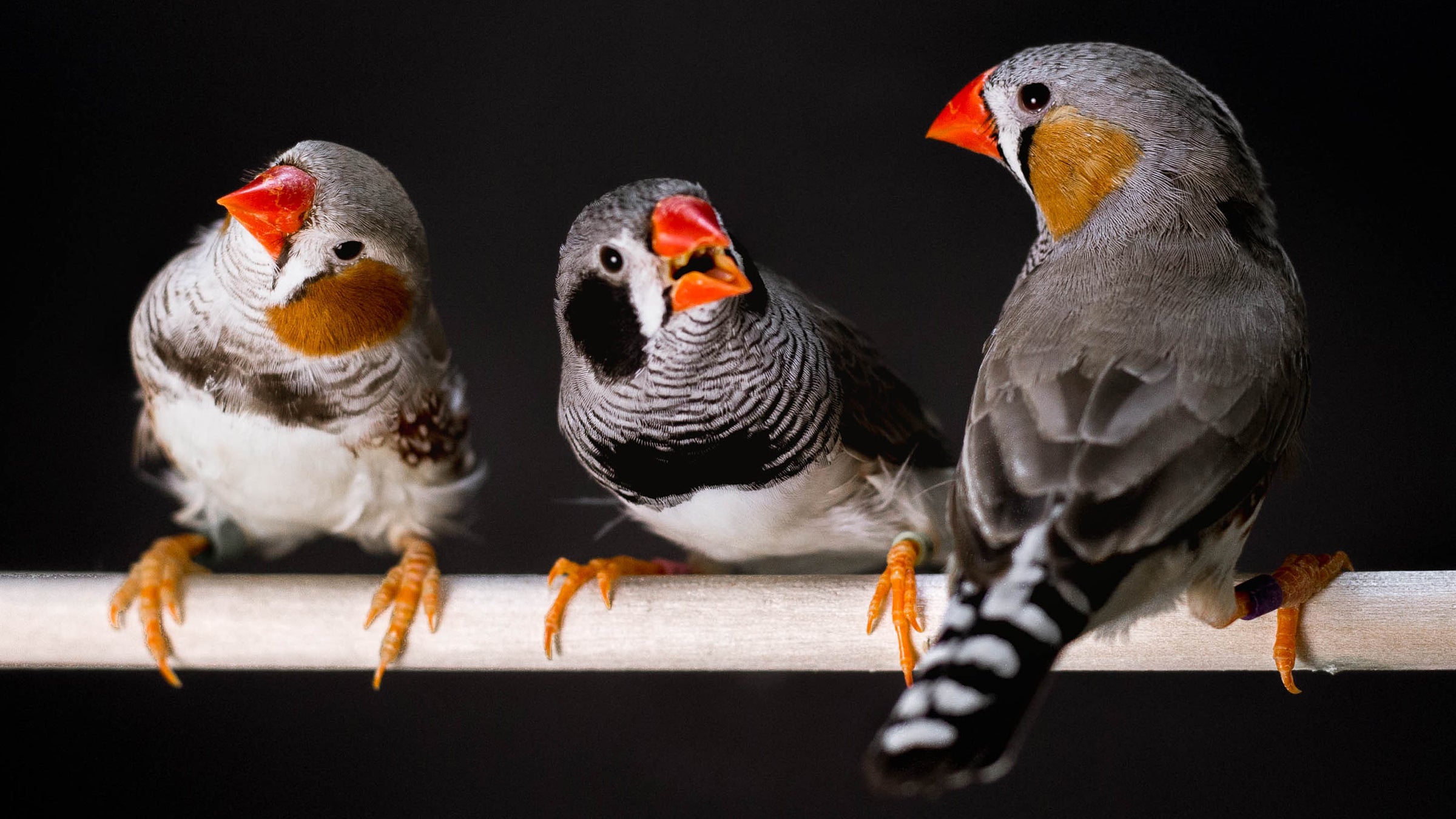
Citizen scientists listened to pairs of mating sounds from 16 different species, including male zebra finches, and selected their favorites. Photo credit: Raina Fan.
The bright colors of butterfly wings, the sweet aromas of flowers and the euphonious melodies of songbirds all evolved as signals to help specific species propagate, but human senses, too, find them pleasing as a rule.
In a study published today in Science, researchers at The University of Texas at Austin and other institutions show that humans and animals express the same subjective preferences for one version of a mating call over another. People and vastly different species also show overlapping preferences for certain specific qualities of an animal’s call. Preferences for some animal sounds are more universal than previously known, the findings indicate.
“This makes a lot of sense, because as the nervous systems and auditory systems of animals evolved, many of the same basic features were conserved,” said study co-author Michael Ryan, Clark Hubbs Regents Professor in Zoology in UT’s Department of Integrative Biology. “There are important differences, but a neuron is a neuron, whichever animal you find it in. So it’s not too surprising that these sounds are sweet to our ears, as well.”
Funding for the study came from the U.S. National Institutes of Health, the Smithsonian Institution, Fonds de recherche du Québec – Nature et technologies and the Royal Society of New Zealand Te Apārangi.
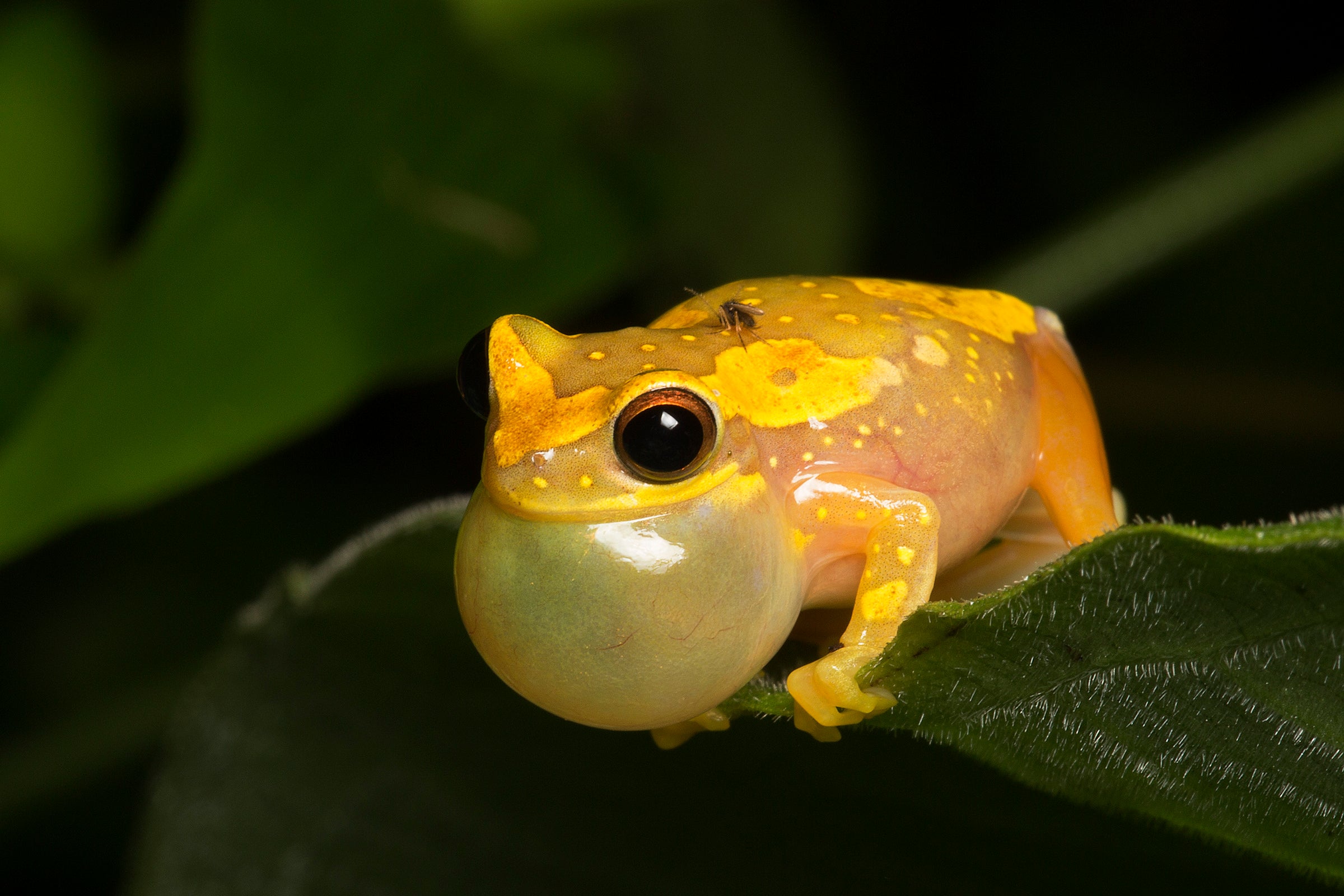
A male hourglass treefrog. Photo credit: Ryan Taylor.
In the early 1980s, Smithsonian Tropical Research Institute (STRI) staff scientist Stanley Rand and Ryan, then an STRI research associate, demonstrated for the first time that in the tropical rainforests of Central America, a female túngara frog’s preference for a mate depends on the complexity of the male’s call. In this new paper, Ryan and his colleagues wanted to know whether human preferences for certain animal calls, including those from male túngara frogs, correlate with the preferences of female animals.
“I became fascinated with the question of where these preferences come from,” said Logan James, a UT research associate and STRI research associate who led the study. “Plus, since that team released their initial findings, we’ve found that other animals, including eavesdroppers such as blood-sucking flies and frog-eating bats, also prefer complex calls. This got us wondering how common acoustic preferences may be.”

In the online computer game Call of the Wild, participants listen to pairs of mating sounds from different animals and chose which of the two they prefer.
The team tested humans’ preferences for different animal sounds using an online computer game. More than 4,000 participants from around the world helped with the citizen science project, listening to pairs of animal sounds from 16 different species across the animal kingdom and then indicating their preference for one or the other. Previous research studies had already established which sound in each pair was preferred by females of that species. The researchers tested whether humans showed a preference for the same sounds the animals preferred.
“In gamified citizen science, people volunteer for experiments simply because they’re fun and interesting,” said Samuel Mehr, an associate professor at Yale University’s Child Study Center and the senior author of the study. “The method is perfect for answering questions from evolutionary biology where we aim to study phenomena across many species as opposed to just a few. Our game enabled us to test lots of humans’ preferences for lots of different sounds.”
The research team found broad overlap between human and animal sound preferences. They discovered that the stronger an animal’s preference for a particular sound, the more likely it was that a human was to select that sound as their favorite. And the human participants were quicker to select the more attractive sound. Agreement between animals and humans was strongest for lower-frequency (lower pitch) sounds and those with acoustic adornments, such as “trills,” “clicks” and “chucks.”
“Darwin noted that animals seem to have a ‘taste for the beautiful’ that sometimes parallels our own preferences,” said Ryan, who is also the author of a popular science book named for the same Darwin quote. “We show that Darwin’s observation seems to be true in a general sense, probably due to the many sensory system properties we share with other animals.”
Other co-authors were Sarah Woolley and Jon Sakata of McGill University and Courtney Hilton of Yale and the University of Melbourne.
Additional images, videos and sounds are available for download here: https://www.dropbox.com/scl/fo/ot7suzb4zn6x9xv02clpr/AAYvK9FRkXswnDUCad7IRCA?rlkey=6to2ndqph5y0adyrkfbif2ris&st=tmea6v7y&dl=0